Now recruiting for our 2027 Hospital Cohort
see here for more
Reflecting on their participation in Expanding Equity’s inaugural Hospital Workforce Leaders Cohort, one participant shared, “I am not alone in navigating these challenges. The pipeline and pathways I want to create can be created — there are people who have done it, and you’ve connected us with those people.” That comment captured the value of bringing together cohorts of hospital workforce leaders working to build high-performing teams and create workplaces where all employees can contribute, grow and thrive.
Hospital systems nationwide are contending with a workforce crisis that shows no sign of easing. High labor costs, rising care demand and an exhausted workforce have pushed registered nurse turnover to record levels, with 42 states projected to face nursing shortages by 2030 and nearly 40% of nurses intending to leave the workforce by 2029. And this is only one occupation within a hospital system. Healthcare is the fastest-growing industry in the U.S. economy, so attracting, retaining and developing talent is a top priority.
This spring, the inaugural hospital workforce leaders cohort brought together 31 workforce leaders representing 15 hospital systems collectively serving over 5 million patients and employing over 400,000 employees nationally to tackle their workforce challenges. Leaders came from different regions of the country and functions at the hospital, sharing practical strategies, testing ideas and learning together. They ultimately identified three shared priorities: building sustainable talent pipelines, retaining staff and creating career pathways that support economic mobility.
Common Challenges and Leading Solutions
Building Sustainable Hiring Pipelines for Hard-to-Fill Roles
Hospital systems continue to face workforce shortages, especially in clinical and frontline roles. In rural regions, hospitals are competing for the same limited pool of credentialed candidates, which drives up wages without solving the underlying pipeline problem.
One participant shared that their four-hospital system has over 1,200 open positions and experiences 22% annual turnover, making it almost impossible to build the kind of stable, experienced workforce that drives quality care.
What’s Working? Strengthening the Workforce Pipeline Before Candidates Apply
Local education and training partners are a critical piece of the pipeline – cohort members describe investing early in talent development and attraction rather than competing for the same limited pool of credentialed candidates.
This includes expanding clinical placements and summer internships into direct hiring opportunities and working with community organizations and workforce intermediaries to develop earn-and-learn programs and apprenticeships. For example, one participant described a five-week summer window with a two-week internship designed specifically to connect students to limited-license roles before the academic year resumes.
Partnerships with high schools and community colleges offer a promising approach as well. Research on healthcare-focused high schools suggests these partnerships can strengthen local talent pipelines when built around strong employer relationships, intentional governance and culturally responsive recruitment.
Retaining Staff in a High-Cost, High-Burnout Environment
In hospital systems, retention is influenced by many factors such as workload, manager quality, scheduling and professional development. This cohort identified three dynamics resulting in higher turnover:
- Onboarding: New hires leaving within the first year because onboarding is inconsistent and manager support is thin.
- Long-term retention: Experienced staff leaving at the three-year mark, just as they’ve hit their stride and become the colleagues newer hires learn from.
- Temporary workers: Heavy reliance on travelers (contract nurses and agency staff), creating frustration among permanent employees who see temporary workers earning higher wages.
Far less data is collected regarding frontline and support staff turnover, even though replacement costs and operational disruption are typically higher for this part of the workforce. When exit data exists, it often points to the same root causes: feeling undertrained, undermentored and without a viable and visible path forward.
What’s Working? Having Shared Dialogue About Retention Challenges
Across organizations, one strategy stood out: asking workers what they need and then visibly and transparently acting on it.
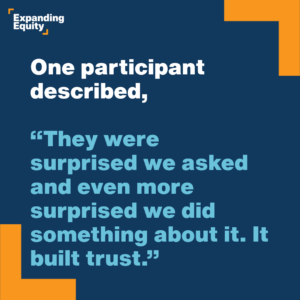
Making retention a shared conversation with employees built more trust than any formal program had previously. Actions like stay interviews, structured 30/60/90 check-ins, career exploration events and peer networking sessions for entry-level workers all create structured moments for workers to be heard and to envision a future for themselves in the organization.
Several cohort members are also building non-manager support such as career coaches, peer mentors and structured check-ins to supplement manager relationships. Several cohort members are making the business case for these investments by highlighting traveler and temporary staff cost data:
When you show someone how much their department is spending on travelers and temps and compare that to the cost of onboarding and discuss retention strategies — that’s an eye opener. That’s the business case.
Creating Real Advancement Pathways for Frontline and Entry-Level Workers
Most hospital systems have formal career ladder programs, but few are able to successfully help frontline workers navigate them.
Credentialing requirements, inconsistent manager support and financial constraints create barriers that workers cannot clear while working full-time and supporting a household, which often includes family and children.
As one participant noted, our expectations are increasingly disconnected from the reality of who is doing this work:
Current employees can’t go to school, work full time, and have a family. Help people see that human side of it — maybe in the past you had more folks who could quit their jobs and go back to school, that’s not as much of a reality now.
Several cohort members revealed that workers frequently report not knowing what professional development options exist at all — not because career pathways are absent, but because no one has walked them through what is possible.
What’s Working? Supporting Employees with Career Navigation Rather than Set Pathways
A key insight from this cohort is the important distinction between career pathways and career navigation.
Career pathways describe a linear route that rarely unfolds as designed, while career navigation describes the supports that help a worker move forward within the constraints of their lives.
The organizations making progress are investing in career navigation, such as:
- Career coaches and peer mentors who provide just-in-time support;
- Apprenticeships designed collaboratively with department leaders;
- Financial support that allows employees to participate in training without sacrificing income; and
- Career exploration events that introduce workers to roles and educational options they did not know were available to them.
What We Learned
The workforce challenges this cohort navigated and the approaches they tested are not unique to their own hospital system – they reflect what workforce leaders across hospital systems are grappling with right now, often in isolation. That’s precisely why this cohort existed: to give practitioners a place to think, strategize and act alongside peers who understand the terrain in which they’re operating.
What the cohort discovered matters. Hospitals are competing for the same limited talent pool instead of building one, either for their own system or collectively as a region. They’re creating isolated career programs instead of navigation support for people who need to advance while working full-time and supporting a family. They’re designing for a workforce that no longer exists. When leaders came together to test different approaches — education partnerships that source talent, stay interviews that catalyze change, and career coaches that provide direction — the shift was clear. The solution isn’t a shortage of candidates or advancement pathways. It’s intentionality, listening and designing for the economic reality of the current workforce.
Join Expanding Equity
This cohort’s work reflects a core belief of the W.K. Kellogg Foundation: creating fairer workplaces is one of the most powerful ways to expand opportunity, strengthen communities and improve organizational performance.
When hospital systems create genuinely inclusive career pathways with economic mobility, they develop a workforce that is better equipped to provide culturally responsive care to the very communities those workers come from.
If you’re looking to build a stronger workforce by creating sustainable talent pipelines, improving retention and expanding career pathways that create opportunity, we encourage you to join the Expanding Equity network.
We bring together senior and workforce leaders in peer learning communities, equipping them with practical tools, real-world strategies and trusted connections to drive impact for employees, businesses and society.
To participate in a cohort or in our network or bring a colleague into the conversation, please reach out to us at [email protected].